
Criminal Court Records in Wagoner County
A criminal court record is the official case file a clerk opens the moment the State of Oklahoma files a charge. In this county that clerk is the Wagoner County Court Clerk, who keeps every criminal docket for the District Court on the first floor of the courthouse in Wagoner. The file holds the charging document, bond papers, each motion, every hearing setting, the plea, the verdict or agreement, and the final sentence order. It grows as the case moves forward. Once a judge enters a disposition, the record shows how the matter closed.
Two kinds of courts produce criminal records in the county. The Wagoner County District Court handles felonies and misdemeanors brought by the State, along with bonds, probation, and payment plans. City ordinance violations are separate. The Wagoner Municipal Court and the Broken Arrow Municipal Court handle local code and traffic matters, and serious crimes from those cities still route to the District Court. For a closer look at how a charge is filed, reduced, or dropped, the Wagoner County arrest records and court charges page breaks down the charging side of a case.
How to Search Wagoner County Criminal Court Records
Most Wagoner County criminal cases can be found online for free. The county points residents to two official tools. On Demand Court Records, known as ODCR, is the search the Court Clerk links for public case lookups. The Oklahoma State Courts Network, or OSCN, carries District Court and appellate dockets statewide. Either one lets you open a case and read its docket, hearing dates, and disposition.
- Open the ODCR portal and pick Wagoner from the court list, or open the OSCN docket search and choose Case Search.
- Search by party name in Last, First format, or enter the full case number if you have it.
- Narrow the results by court, case type, and filing date to reach the right defendant.
- Open the case to read the docket entries, hearing dates, charges, plea, and disposition.
- Request a certified copy from the Court Clerk if you need a document for legal use.
Case numbers follow an Oklahoma pattern. Felonies use a CF prefix and misdemeanors use CM, each followed by the year and a sequence number. For criminal history beyond a single county docket, the Oklahoma Department of Corrections offender lookup shows people sentenced to state prison. Records that never appear online, including older or sealed files, are requested directly from the Court Clerk.
Note: ODCR offers free public searching of Wagoner County dockets, though downloading certain filed documents may take extra steps or a fee.
Stages of a Wagoner County Criminal Case
A criminal case moves through set stages, and each one leaves a mark in the record. Reading those marks in order tells the story of the case from start to finish.
Case flow: Charges Filed › Arraignment › Pretrial and Motions › Plea or Trial › Disposition › Sentencing
Charges are filed when the District Attorney signs an information or a grand jury returns an indictment. At arraignment, the defendant hears the charges and enters a first plea. Pretrial covers motions, discovery, and bond review, and the docket fills with these entries. The case then ends in a plea or a trial. Disposition is the outcome of each count, and sentencing sets the punishment when there is a conviction.
Bonds, continuances, and failure-to-appear entries can show up at any stage. A bench warrant noted on the docket usually means the defendant missed a court setting. Each of these events appears as a dated line, so the docket reads like a timeline of the case.
What a Wagoner County Criminal Court Record Shows
A Wagoner County criminal court record reads as a set of fields tied to one case number. Knowing what each field means turns a confusing docket into a clear timeline of charges and outcomes.
| Field | What It Shows |
|---|---|
| Case Number | The court's file number, with a prefix such as CF for felony or CM for misdemeanor, plus the year and sequence. |
| Court and County | Identifies Wagoner County District Court or the relevant municipal court that holds the case. |
| Defendant | The person charged, listed as the party against the State of Oklahoma. |
| Charges and Counts | Each filed count, the statute cited, and any amended or reduced charge. |
| Bond | The bond amount and type set for release, posted through the Court Clerk. |
| Plea | The defendant's formal response, such as guilty, not guilty, or no contest. |
| Hearings | Dates and times of arraignment, pretrial, and trial settings. |
| Disposition | How each count ended: conviction, dismissal, or acquittal. |
| Sentence | The punishment ordered, including jail, prison, fines, probation, or restitution. |
| Financials | Fines, court costs, restitution, and any payment-plan activity. |
Reading Criminal Dispositions and Sentences
The disposition is the heart of the record because it says how each charge ended. One case can hold several dispositions, one per count, and they do not always match. A few common terms unlock most of the docket.
- Guilty
- The defendant admitted the charge or a jury found them guilty, which creates a conviction.
- Not Guilty
- A plea of denial, or an acquittal at trial, which means no conviction on that count.
- Dismissed
- The court dropped the charge. Dismissed with prejudice cannot be refiled; without prejudice can.
- Nolo Contendere
- A no-contest plea that is treated as a conviction for most purposes.
- Deferred Sentence
- Judgment is held back while the defendant meets conditions, and the case may be dismissed if they comply.
- Suspended Sentence
- A conviction is entered, but the time is held over the defendant while they follow probation terms.
A sentence can combine jail or prison time, fines, court costs, restitution to victims, and probation. Reading the disposition and the sentence together shows both the result and the consequence for each count.
Charges vs. Convictions in Criminal Records
Being charged is not the same as being convicted. A criminal court record can list charges that were later dropped, dismissed, or that ended in an acquittal. The two carry very different weight, and the gap matters for anyone reading a file.
| Charge | Conviction | |
|---|---|---|
| Stage | Accusation by the State | Verdict or plea at the end |
| Burden of Proof | Probable cause | Beyond a reasonable doubt |
| Who Decides | The District Attorney | A judge or jury |
| Meaning | The case has begun | Guilt is established |
| Public Record | Yes | Yes |
A filed charge shows only an accusation, not proof of guilt. The disposition field is where the docket confirms whether that charge ever became a conviction.
Jail Booking vs. the Criminal Case File
The jail side and the court side of a case are two separate records. A booking sheet at the county jail lists the charges an officer noted at arrest. The court file lists the counts the District Attorney actually filed, which can differ.
Booking charges can be broader, narrower, or simply different from what the prosecutor files days later. A person can be booked on one charge and formally charged with another, or released with no charge filed at all. The District Court file is the authoritative record of what the State chose to pursue. The broader set of civil, family, and probate files alongside criminal cases is covered on the Wagoner County court records overview.
Important: Jail booking charges are not filed criminal counts. Only the District Court case file shows the charges the prosecutor pursued and how each one was resolved.
Wagoner County District Attorney and Appointed Counsel
Criminal charges in Wagoner County are filed and prosecuted by the District Attorney for District 27. The same district also covers Adair, Cherokee, and Sequoyah counties, and the office works from the courthouse in Wagoner. The prosecutor decides which counts to file, amend, or dismiss as a case develops.
District Attorney, District 27
Jack Thorp, District Attorney
307 E. Cherokee
Wagoner, OK 74467
918-485-2119
Defendants who cannot afford a lawyer are represented through court appointment, not by hiring counsel through any website. The Oklahoma Indigent Defense System, or OIDS, provides that representation for non-capital trials in the county. The OIDS homepage explains its mission to give people who cannot afford a lawyer representation that matches what paying clients receive.
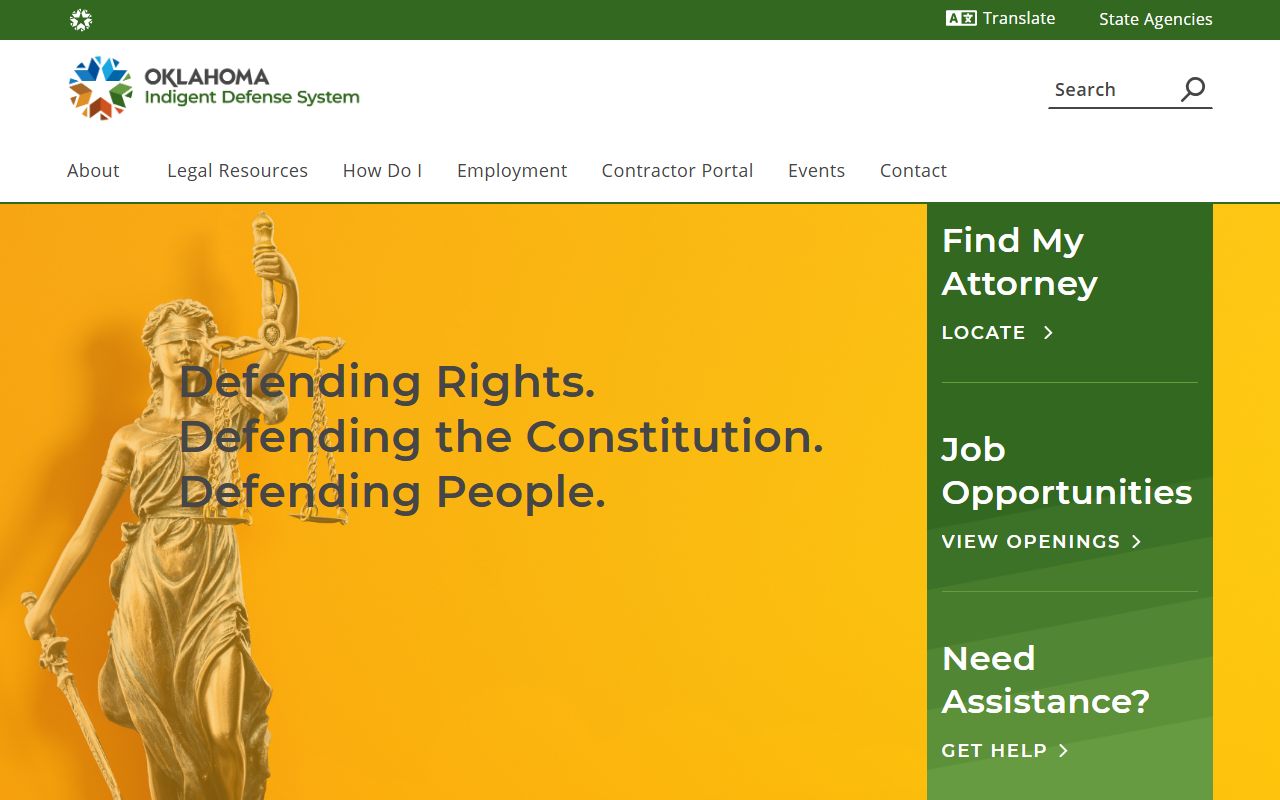
For Wagoner County, that work is carried out by a contracted attorney rather than a stand-alone county public defender office. OIDS also publishes a coverage map that confirms which counties fall under its non-capital trial division. The OIDS Wagoner County coverage page lists the local contract contact for appointed criminal defense.
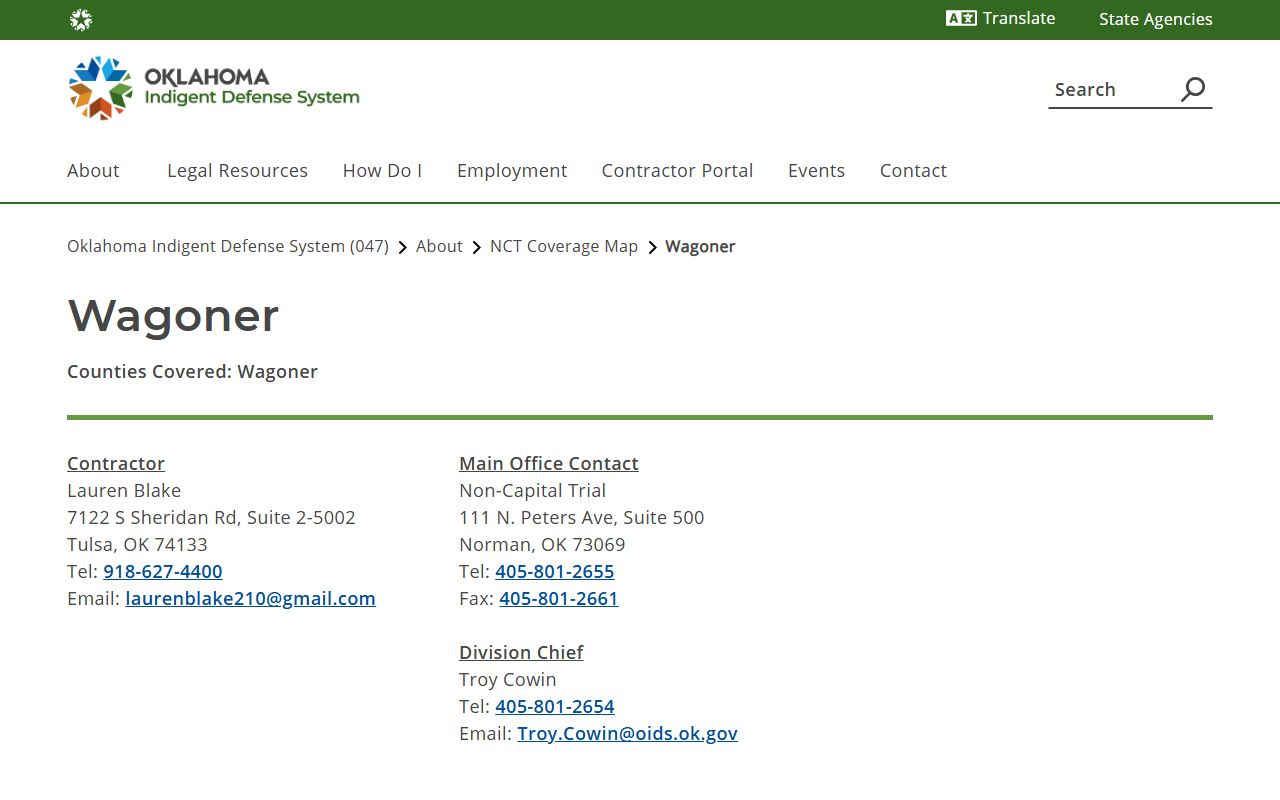
Appointment of counsel is decided by the judge after a defendant shows they qualify. The case file notes when counsel is appointed, so the docket reflects who represents the defendant.
OIDS Non-Capital Trial (Wagoner contract)
Lauren Blake
7122 S Sheridan Rd, Suite 2-5002
Tulsa, OK 74133
918-627-4400
Specialty Courts in Wagoner County
Not every criminal case ends in a standard sentence. Wagoner County runs several problem-solving courts that combine supervision with treatment, and the official county Courts page lists a direct phone line for each program.
- Adult Drug Court, Wagoner: 918-485-7774
- Adult Drug Court, Tahlequah: 918-207-0949
- Mental Health Court: 918-485-7991
- Community Sentencing: 918-485-5083
- Juvenile Drug Court: 918-485-7746
These programs are case-specific. Entry usually requires review by the prosecutor, the defense, treatment providers, and the judge. Community Sentencing ties supervision to a criminal disposition, while Mental Health Court can keep a docket entry public even when the treatment details behind it stay confidential.
Note: A place on a specialty court docket is decided case by case and cannot be requested through an online court search.
Sealed vs. Expunged Criminal Records
Some criminal records leave public view. Oklahoma law lets qualifying records be sealed or expunged, and the two are not identical. Both can make a search come back empty, but they work in different ways.
| Sealed | Expunged | |
|---|---|---|
| Visibility | Hidden from public search | Treated as though it never existed |
| Law Enforcement | Limited access remains | Very limited access |
| How It Happens | Court order on petition | Court order on petition |
| Main Statute | 22 O.S. Section 18 | 22 O.S. Section 18 (adult); 10A O.S. Section 2-6-109 (juvenile) |
Adult expungement runs under 22 O.S. Section 18, which sets the eligibility categories. Juvenile records follow a separate process under 10A O.S. Section 2-6-109. A petition is filed in District Court, notice goes to law enforcement and the prosecutor, and a judge weighs privacy against the public interest. After a record is sealed, a public search may return no result. Fees, waiting periods, and notice rules depend on the case, so the Court Clerk or an attorney should confirm eligibility.
Public Access to Wagoner County Criminal Court Records
Oklahoma treats court records as public by default. The Open Records Act and the court rules keep criminal case files open unless a statute or a judge's order makes them confidential. That default is what lets anyone read a Wagoner County docket online.
Key Statutes:
Oklahoma Statutes title 51 § 24A.30 - Court records are public unless another law makes them confidential, and sealing generally requires a court order.
OCCA Rule 2.6 - The online ODCR and OSCN database is a convenience copy and does not replace the court's official case-management record.
Because the online docket is a convenience copy, the Court Clerk's certified record controls if the two ever disagree. For a document that must hold up in court, request a certified copy from the clerk rather than printing a page from the public portal.
Restricted Criminal Court Records in Wagoner County
Some criminal matters stay out of public search no matter how a person looks. Juvenile delinquency and deprived cases are generally confidential under Oklahoma law, and only program information appears publicly. Sealed and expunged adult cases drop off the public docket once an order is entered.
Mental health proceedings and certain protected materials can also be withheld or redacted. Court rules tell filers to limit Social Security numbers, dates of birth, financial account numbers, and home addresses in public filings. When a record does not show online, the Court Clerk can confirm whether it exists, is sealed, or simply has not been digitized yet.
Important: This site is a private resource and not a consumer reporting agency, so its records cannot be used for employment, credit, tenant, or other FCRA-regulated decisions.