
Wagoner County Arrest Records and Court Charges
An arrest record is the law enforcement account of a stop and a booking. In Wagoner County, the arresting agency is usually the Sheriff's Office or a city police department. The record can list the arrest date, the agency that made the arrest, and the booking charges read at intake. Those booking charges are preliminary. They reflect what an officer believed at the scene, not the final counts a court will weigh. The arrest by itself does not decide guilt.
The court charge record begins later. A prosecutor with the District Attorney's office reviews the arrest, then decides which charges to file with the Court Clerk. Those filed counts, not the booking notes, drive the case. The custody and booking side, including the jail roster, lives on the Wagoner County inmate records page. The full case file, with pleas, disposition, and sentence, sits in the county criminal court records. The charge record is the bridge between the two, and the charges after arrest can change as a prosecutor reviews the evidence.
The Sheriff's Office explains booking and jail intake on its Wagoner County Jail page, which handles the arrest side of the process.
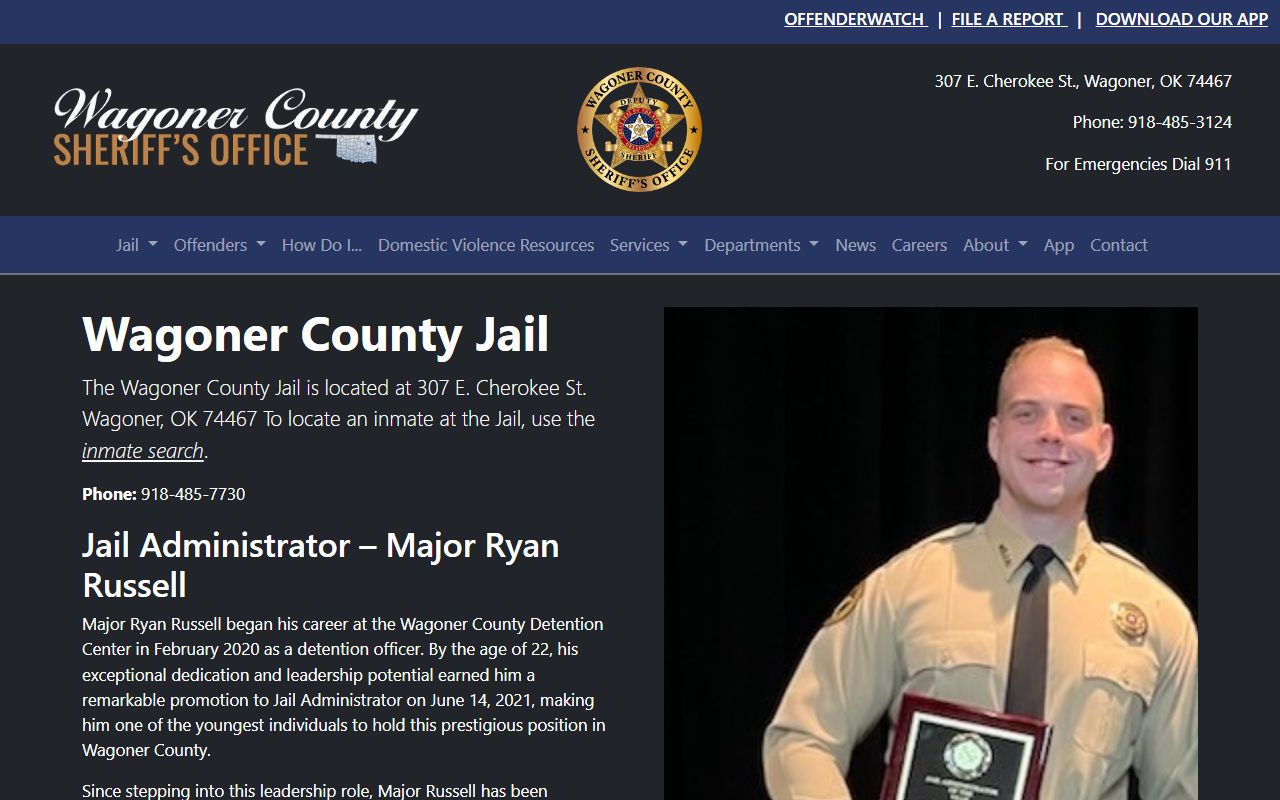
That intake is where booking charges first appear, before any prosecutor files the formal court charges that the District Court will track.
Who Files Wagoner County Charges
Charges are not filed by the police or by the jail. In Wagoner County, that job belongs to the District Attorney for District 27. District 27 covers Wagoner, Adair, Cherokee, and Sequoyah counties. District Attorney Jack Thorp leads the office. Prosecutors there review each arrest, weigh the evidence, and decide what to charge. They can file every count an officer listed, file fewer, file different counts, or decline to file at all.
The office also runs programs tied to its charging work, including a Bogus Check Restitution Program, child support enforcement, and crime victim services.
Wagoner County District Attorney (District 27)
307 E. Cherokee
Wagoner, OK 74467
918-485-2119 (fax 918-485-4220)
Mon-Fri 8 AM to 4:30 PM
How to Find Wagoner County Arrest Records
Filed charges show up in the court case index, not on the jail roster. Wagoner County links two free search portals. On Demand Court Records, known as ODCR, is the county's main public search. The Oklahoma State Courts Network, or OSCN, carries the same District Court dockets statewide. Both let a reader pull a criminal case and read the counts a prosecutor filed.
- Open the ODCR portal and pick Wagoner from the court list, or use OSCN and choose Case Search.
- Search by party name in Last, First format, or enter the full case number if you have it.
- Open the matching case to view the docket, the hearing dates, and the list of filed charges.
- Check each charge for its statute code, its severity level, and its current status.
Booking charges from the arrest itself sit in a different place. The Sheriff's Office posts an inmate search that shows in-custody bookings, booking dates, and the charges read at intake. The WCSO mobile app packages that same inmate information and recent arrests into one channel, alongside wanted-person listings and anonymous tips. For released or transferred people, VINE Link tracks custody status.
How Wagoner County Charges Get Filed
After booking, the charge record starts when the prosecutor files a charging document with the court. That document names each count, cites the statute, and states the level. Oklahoma uses three main charging instruments, and the one used depends on the offense and on how the case enters the court.
| Complaint | Information | Indictment | |
|---|---|---|---|
| Filed By | Officer or prosecutor | Prosecutor | Grand jury |
| Common For | Misdemeanors | Many felonies | Serious felonies |
| Starts | The case | The case | The case |
Misdemeanor cases in Wagoner County commonly open with a CM case number, while felony cases open with a CF prefix. The prefix signals the charge level before you even read the counts.
Wagoner County Charge Codes and Severity
Every charge ties back to a specific Oklahoma statute. The docket prints that statute number next to each count. The number points to the offense and its severity. Oklahoma sorts crimes mainly into felonies and misdemeanors, with lower-level municipal violations handled by city courts. A single arrest can spin off several separate charges, and each one carries its own code and its own status.
- Statute citation: the Oklahoma law the count is filed under.
- Charge level: felony or misdemeanor, which sets the possible penalty range.
- Case-type prefix: a felony case opens with CF, a misdemeanor with CM, and a District Court traffic matter with TR.
- Count number: each separate charge in the case is numbered.
- Status: the current state of that count, which can shift as the case moves.
Charge Status in Wagoner County Cases
Charges rarely stay frozen. As a case moves, a prosecutor can amend a count, reduce it, add a new one, or drop it. A judge can dismiss a charge. The docket records each change, so the status you see is the current one, not always the original booking charge. Reading the status correctly is the difference between thinking a person faces a felony and seeing that the count was reduced or dropped.
| Status | What It Means |
|---|---|
| Pending | The charge is filed and active, with no final outcome yet. |
| Amended / Reduced | The count was changed, often to a lower level or a different charge. |
| Dismissed | A judge ended the charge, with or without prejudice, which controls whether it can be refiled. |
| Nolle Prosequi | The prosecutor chose not to pursue the charge and dropped it. |
Note: A dropped or dismissed charge can still appear in the court record, which is why expungement exists for cases that qualify.
Statewide Charge and Criminal History Lookups
County dockets show charges filed in Wagoner County. A statewide view is different. Once a defendant is convicted and sentenced to state prison, the Oklahoma Department of Corrections, known as DOC, tracks that person rather than the county jail.
The DOC explains its public tools on the Oklahoma DOC offender information page, which gathers offender lookup, open records, and registry links in one place.
That page is the right starting point for charges that ended in a state-prison sentence rather than a county outcome. For an individual offender, the DOC also runs a dedicated search.
The Oklahoma DOC offender lookup returns sentenced state-prison offenders by name.
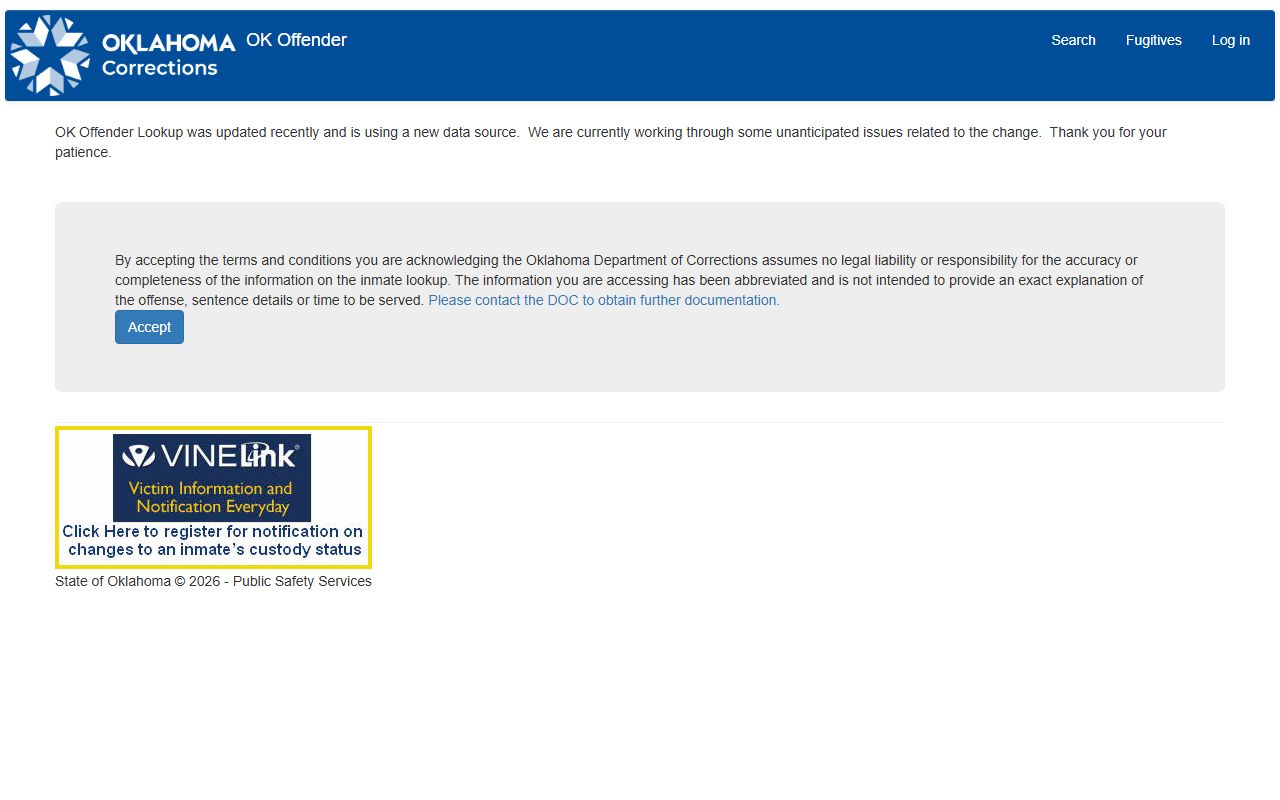
It does not show county booking charges, so pair it with the county docket and the jail roster for a full picture. Oklahoma also keeps a public sex offender registry for convictions that require registration. These statewide systems list outcomes, not arrest records, so they confirm convictions rather than the charges first filed after a Wagoner County arrest.
Charges vs. Convictions
A charge is an accusation. A conviction is the outcome. The two can look alike on a docket but mean very different things. A filed charge says the State believes there is probable cause. A conviction says a court found guilt beyond a reasonable doubt, or the defendant pleaded to it. Many Wagoner County charges never become convictions. They get reduced, dismissed, or dropped along the way.
| Charge | Conviction | |
|---|---|---|
| Stage | Accusation | Verdict or plea |
| Burden of Proof | Probable cause | Beyond a reasonable doubt |
| Decided By | Prosecutor | Judge or jury |
| Public Record | Yes, while active | Yes, unless sealed |
Expungement After a Wagoner County Dismissal
A dismissed or dropped charge can still show up in a public search. Oklahoma lets people clear qualifying records through expungement. Adult criminal expungement runs under 22 O.S. Section 18, which lists the eligibility categories. The petition is filed in District Court, names the records and the agencies involved, and states the legal basis. A judge weighs privacy against the public interest before granting it.
- Sealed record
- Hidden from public view but still kept, with limited access for law enforcement and the courts.
- Expunged record
- Removed from public access and treated as if the arrest or charge never happened.
- Eligibility
- Set by statute. A dismissal, an acquittal, or a completed deferred sentence can open the door, but waiting periods and case type still matter.
Juvenile records follow a separate path under 10A O.S. Section 2-6-109. Because fees, waiting periods, and notice rules vary, the Court Clerk or an attorney should confirm eligibility before anything is filed.
Wagoner County Sheriff Records Requests
Some arrest and booking details never appear online. Incident reports, booking documents, and law enforcement video go through the Sheriff's Office Records Division. A crime victim can receive a first copy of a report at no charge with valid ID. Some records are released only by subpoena.
The Sheriff's Office lists its hours, ID rules, and fees on the WCSO Records page.
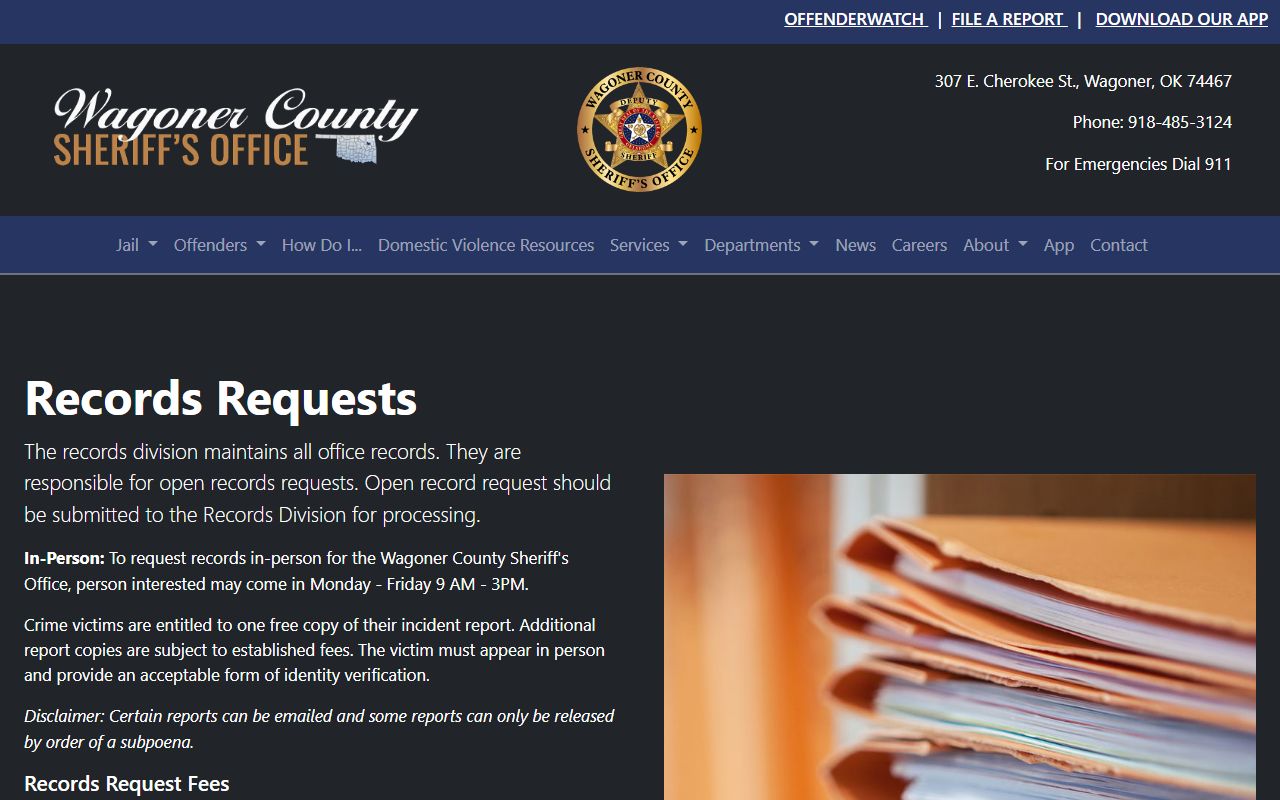
Those posted fees set what a copy of a Wagoner County arrest or incident report costs. The published schedule covers the common requests:
- Public incident reports: $0.25 per page.
- Document review and redactions: $20 per hour.
- Video review and redaction: $30 per hour.
- External thumb drive: $10 each.
- Court documents: released by approval only, for signatures and paper delivery.
Background Check Considerations
Looking up a charge for personal knowledge is one thing. Using it to decide on a job, a lease, a loan, or insurance is another. Those decisions fall under the federal Fair Credit Reporting Act, which requires a licensed consumer reporting agency and added steps. A casual docket search of Wagoner County records does not meet that standard.
Important: This site is a public resource, not a consumer reporting agency under the FCRA, so its information cannot be used for credit, employment, tenant, or insurance decisions.
Restricted Charge Records in Wagoner County
Not every charge is open to the public. Juvenile cases are usually confidential under Oklahoma law. Sealed and expunged charges drop out of public search results. Records tied to an active investigation can be withheld until the matter resolves. Personal identifiers such as Social Security and account numbers are limited under court rule.
Court records in Oklahoma are public by default under the Open Records Act, 51 O.S. Section 24A.1 and following. Section 24A.30 confirms that court records stay open unless a statute or order makes them confidential, and sealing generally needs a court order. OCCA Rule 2.6 adds that the online docket is a convenience copy, while the Court Clerk's case-management file is the official record.